
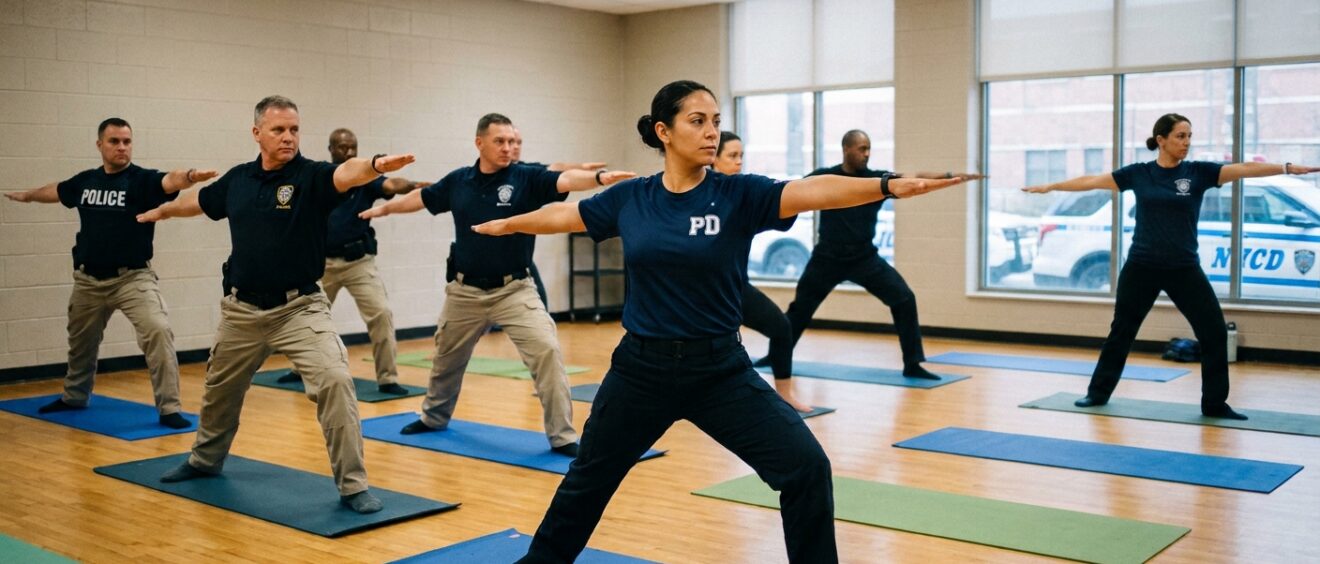
Yoga for Trauma, Healing & Recovery Part 1: Trauma In Law Enforcement
Featuring 5 Koshas Teacher: Bill Miller, RYT-500
Imagine a career path—providing a thread that will weave through your life—beginning in Vietnam. You are working alone, doing semi-clandestine investigative work, always having to be hyper-alert to your surroundings, keeping an eye out for places to find cover or protection if pursued.
The trauma can take its toll. And it did for Bill Miller, MA, RYT-500 and Certified Viniyoga Teacher at 5 Koshas. Vietnam was a formative experience, and in some ways, set him up for careers in law enforcement, mental health counseling supporting law enforcement and first responders, teaching criminal justice and eventually teaching and practicing Yoga.
Here in his own words, Bill reflects on his journey and how Yoga became a tool to enhance his trauma recovery.
Trauma In Law Enforcement: A Personal Perspective
My brother found an old article on police stress that appeared in a 1984 Milwaukee Journal newspaper titled, “A Lesson In Policing Stress.” The article included a photo of me punching a heavy bag. At that time, I was a sergeant at the City of New Berlin Police Department and the person quoted extensively in the article was the then Chief of Police, who had given a speech on police stress. The chief talked about several of the issues that had been coming up in discussions of police stress, so he had a police psychologist give a talk to our department about stress and police families. Some might say the chief was on the leading edge of innovation in policing, including creating conditions for stress reduction.
Social Work Gains Ground
The New Berlin Police Department had hired a police social worker in 1977 under a two year grant. The program was a success and the city continued to fund the position after the grant had expired. The social worker focused on interviewing victims of child physical and sexual abuse and neglect, as well as victims of sexual assault, but there was no thought of having her address stress-related concerns of the officers. For a while, she and I shared an office, and I observed officers hanging around our door, waiting to talk to her.
In time, the city approved hiring additional police social workers, one in particular who learned alongside officers and dispatchers on scene-of-death calls to fully understand what these officers and dispatchers experienced first-hand.
Vietnam and Lingering Trauma
At this point in my life, there was little talk of “trauma.” It seemed that stress was in the air and everyone was talking about it, but not about trauma. It wasn’t until several years later that I would find myself driving to the Vet Center in Milwaukee for therapy for post traumatic stress disorder (P.T.S.D.). I thought I was exhibiting some of the signs of P.T.S.D., and a friend who knew I was a Vietnam veteran, encouraged me to seek help.
In Vietnam, I had worked alone in a semi-clandestine role as an investigator, tracking material that was being stolen in a certain area. My area of responsibility lay along an approximate four mile stretch of road from the ship that the material was off-loaded from to the covered storage complex outside of Danang. Sometimes I drove, and at other times I would hitch a ride.
I was always very aware of my surroundings, keeping an eye out for places to find cover in case of a rocket attack or places to find protection if I was pursued. I reported in once a week to a senior officer, typing up reports on my findings for the Admiral’s office in downtown Danang. I had done little favors for some of the Vietnamese who worked in the covered storage complex. I would do occasional favors for some of the Vietnamese who worked for the U.S. Government, primarily as laborers. I also spent some time with them sampling their food and buying them sodas in return.
I relied on many of the Vietnamese whom I had befriended for information. They were concerned for my safety, so I would frequently be told when our camp or other areas that I frequented would be attacked. Most attacks were rocket and mortar attacks.
In hindsight, it seems that I was always in a state of heightened awareness, looking for the closest bunker in case one might be needed; watching others, both Vietnamese and G.I.s, to make sure that they had benign intentions; and the big one, which was to quickly plan an escape route in my mind, just in case.
Even now, I sometimes find myself looking for escape routes. When I walk into a large store, I will sometimes look for areas where I can quickly exit outside. I have done the same when teaching, whether to a group of criminal justice students or to a yoga class. In either case with teaching, I am most concerned with how to keep students safe. Something that I work on constantly is my startle reflex, a by-product of P.T.S.D. A loud, sudden noise can start my heart racing. I then focus on my breath, using breath practices that I learned from my yoga teacher.
Seeking Help, Helping Others
Although I thought there were other veterans who were much worse off than me, I called and made an appointment to see a therapist at the Milwaukee Vet Center. My assumption was that she or he would find that I was fine and did not need therapy.
That was not to be the case. After individual therapy, I became part of a veteran’s support group at the Vet Center. I was finally able to talk to others who understood what I had experienced years before and had never really talked about to anyone.
The air around me had cleared, finally. My mind had cleared. I could sleep at night and was not so prone to anger or fear. I became a little more trusting, something that I still work on. And I was able to pay it forward helping others in the police department.
The chief in New Berlin took an interest in learning more about my therapy and he wanted to do more for our officers. While he could be a little rough around the edges, he had a good heart and cared about others. He wanted to make a difference in the lives of others, and he wanted his officers to do so as well. At this point, I had an undergrad degree and was in the process of finishing up a masters degree in sociology, with emphasis in criminology. The chief wanted to understand more about what I was learning and how it could be applied to police work in New Berlin.
Slowly, the terms trauma and post traumatic stress disorder began creeping into discussions about police stress, sometimes used interchangeably with the word “stress.” It was more than stress though.
We had a copy of the Diagnostic and Statistical Manual of Mental Disorders (DSM-3) back in the investigation area of the Department. The DSM was a publication by the American Psychiatric Association of mental illnesses and diagnoses. A couple of us had received training from the F.B.I. in crime profiling and we used the DSM-3 occasionally to figure out who we
might be looking for as a suspect in a crime. The DSM-3, published in 1980, was the first time that trauma was mentioned as a mental disorder. The term P.T.S.D. was used to differentiate stress as a condition that did not reflect one’s individual weakness to stress. It was an external, traumatizing experience. It was overwhelming in its effect and included a list of symptoms, including hyper vigilance, sleep disorders, emotional numbing, fear, inability to concentrate, to name a few.
Ultimately, the DSM-5, published in 2013, revised the definition of trauma and P.T.S.D. Rather than being found under the general classification of Anxiety Disorder, DSM-5 and further revisions moved it under a new classification, Trauma and Stressor-Related disorders.
I think that because of my own experience in Vietnam, I was more aware of how traumatic incidents could and would affect crime victims down the road, especially young victims. It could also affect how some crime suspects behaved.
My path continued in the direction of helping others, with trauma a constant thread. I was asked to lead a support group for domestic abuse perpetrators. While there was some fear of possible violence in the group setting, I agreed to do it and underwent training in resolving potentially violent conflict in a group setting.
Back then, there was no domestic abuse mandatory arrest law in Wisconsin. Those who signed up for the group did so voluntarily. The mandatory arrest law was implemented in 1989, and I was asked to teach this new law to police officers throughout the County in in-service training. Not long after the law was implemented, the domestic abuse group began expanding. Many who had been arrested and convicted had a choice between jail or my group. If they chose the group, they had to report to the group on time and behave themselves. A phone call was all it took to have an uncooperative person picked up and conveyed to jail.
Over the next several years, the group met once a week for a couple of hours. I learned what many of the guys had been through and would speak occasionally to a therapist about how to handle certain situations involving men with multiple addictions as well as trauma.
A Turning Point
Without realizing it, I was in the process of learning more about trauma and how it affects thoughts and behavior. After several years of doing groups, I had to get out of it. I sometimes felt that I was taking a bandaid approach to a problem much deeper than what I could address in a group setting. It was time to move on.
A year or two afterward, I was asked to be a “mental health person” for the Waukesha County Critical Incident Stress Debriefing Team (C.I.S.D.). After going through the requisite training, I waited to be called out on my first debriefing. My team included two assistants—a paramedic and a police officer. We were called out many times for various types of debriefings: first responders from fire departments, emergency room staff at local hospitals, police-involved shootings, to name a few.
The purpose of critical incident stress debriefing was to give first responders and others involved in critical incidents a chance to talk about what they had experienced. Our goal was to leave them a little less traumatized and more willing to continue as effective members of their
departments. My job was to give everyone involved a chance to talk about what she or he had done at the scene. Most were willing to talk about the “fact” stage, which was what they had done at the scene. Invariably, no two people experienced the same incident the same way.
One person said it seemed that it took her two minutes to run an IV into the arm of a car rollover passenger. The person next to her said it was more like two seconds.
After having attendees talk about what they saw or did, we would then go into the “feeling” stage. The question usually asked was, “What did you feel when you went off autopilot, when you had a chance to think about what you had experienced?” The room would grow quiet.
My experience was that if one person would begin, others would slowly join in. One or two might get up to leave the room, and we would encourage them to return, because others could benefit from their observations, too.
Without realizing it, I was becoming more educated and more experienced in recognizing what trauma and P.T.S.D. really were. Later research on critical incident stress debriefing found that it was not effective in addressing trauma, however. There was simply too little time spent on a therapeutic approach to something much more deep-seated than job stress.
There was a difference between P.T.S.D. and stress or anxiety. The Police Department was recognizing the difference also. When one officer was witness to a suspect shooting himself in the head, the officer was ordered to see a therapist. I was told to drive the officer to and from his appointments. I remember to this day the officer’s comment that he could have used the therapy 10 years earlier, but he thought he would be seen as weak. The environment back then was to say you were “okay,” as a negative response was thought to create distrust of the officer in the minds of other officers.
Teaching the Next Generation
After a couple of decades in police work, and turning down a Chief of Police position, I decided to move on to teaching. I wanted to make change in policing, in how officers were selected and retained. Also, my growing education and experience with trauma convinced me that more needed to be done.
When offered a teaching job in criminal justice at Northcentral Technical College (N.T.C.) in Wausau, I accepted. I would also be teaching in the police recruit academy there. I would weave trauma education into lectures whenever I had a chance, not labeling them as such but rather talking about certain kinds of behavior or speech that might indicate symptoms of trauma and/or P.T.S.D. There would be occasional informal conversations with individual students about their own lives and how their experiences might affect their possible future roles as police officers.
Discovering Yoga
After retirement, I was asked by my wife to accompany her to a yoga class. I resisted but eventually agreed. It wasn’t as difficult as I thought it might be, and I was beginning to enjoy it. As I became more involved in the physical practice of yoga, I began thinking of teaching yoga. I was in my late 60s at the time. I met with a local yoga teacher, Mary Hilliker, to see if she thought me too old. She stressed that more male teachers and older teachers were needed and encouraged me to sign up for teacher training. I did, and began teaching up to seven classes a week.
Two classes were ones that Mary had developed, and I was to be her long-term sub when she was unavailable. One of her classes was a therapeutic yoga class. I had some understanding of human anatomy and physiology and some understanding of stress and trauma. The type of yoga that I had begun teaching for Mary combined physical adaptations that, combined with specific types of breath practices, could enhance feelings of well-being while reducing stress, anxiety and trauma. I was introduced to Patanjali’s “Yoga Sutras,” which consisted of almost two hundred threads of thought on living an ethical life and specifically on reducing or eliminating “mind stuff.” This was right up my alley!
After the initial 200 hours of yoga teacher training, I was accepted into an advanced, 300-hour course offered by the American Viniyoga Institute and taught primarily by Gary Kraftsow. Gary had been taught by T.K.V. Desikachar in India, and Desikachar had been trained by his father, T,
Krishnamacharya, who is considered the “Father of Modern Yoga.” He transformed yoga, to the extent that he advocated and practiced linking conscious breathing to sequential movement. It wasn’t about one’s ability to go into “pretzel poses.” It had much more to do with combining even basic yoga postures with specific breath practices, some of which enhanced relaxation and others that enhanced energy. The goal has always been to reduce the random “mind stuff” we humans experience. It seemed to fit right in with a therapeutic approach to trauma and P.T.S.D.
Over time, I also signed up for a weekend training program in Chicago on teaching yoga to P.T.S.D.-diagnosed veterans. There were about eight veterans in the class of about 35. I was the oldest vet. My impression was that at least several of the non-veteran teachers in the class were reconsidering their desire to teach yoga to those with a P.T.S.D. diagnosis. They quickly began to realize that a trauma-informed approach is not a one-size-fits-all approach, although certain ground rules are universal.
Some of the universal ground rules include:
- allowing attendees to set up where they want to (usually along the wall);
- not walking behind attendees if at all possible;
- telling attendees that you are moving to a different location in the room (“I’m going over to turn down the heat.”);
- avoiding loud noises (rolling out yoga mats from a standing position, slapping the floor in the process);
- choosing language carefully so as not to exacerbate trauma. (For example, at one time, I would not have responded well to a teacher asking us to visualize walking down a moonlit road on a warm, summer night.)
Developing and maintaining trust is so important. Trust is a big issue among veterans. Speak frankly. Speak truthfully. A yoga teacher is not a mental health therapist and should not put herself/himself in a position to be considered a therapist by a student who is looking for someone to help.
I was trained in several types of crisis intervention, including hostage negotiation and of course critical incident stress debriefing, working with domestic abuse batterers and working with victims of sexual trauma. It was repeatedly stressed that one should not attempt to help others with their trauma if one’s own trauma remains unresolved. Get help for yourself and get it resolved first before attempting to help anyone else. Another person’s traumatic experience is not the same as yours. Do not try to project your own feelings onto another person, especially one asking for help. Stick to what you know. Listen well. Talk only to guide. If you don’t know the answer, say that you don’t know.
Yoga does not resolve trauma. It is a tool that can help enhance one’s path to trauma recovery if used correctly. From my own experience, it is not the physical postures of yoga as much as how I use the postures along with a certain breath practice to reduce any symptoms of trauma that I might be re-experiencing.
Yes, it would have been good if I had known years ago what I know now about the therapeutic effects of yoga. However, I am a better person, a more content person, because of the adaptations I have used in my own yoga practice based on what I know about trauma. Just ask my wife, who has had to deal with me for the past 58 years.